Leon Yang
Leon Yang
Scaffolding The Margin
New York City is an international city, but its unhoused population cannot be ignored anymore. According to the report from the White House, 0.2% of the American population lives in a state of homelessness without proper shelter and the 5 areas with the most homeless are the District of Columbia, New York, Hawaii, Oregon, and California.
As it becomes more and more gentrified, New York City still has many residual spaces that are left underdeveloped. As Manuel Castells and David Harvey have written, inequality in investment leads to uneven development throughout cities. Yet underdeveloped areas have the potential to become a place for social welfare as living spaces for unhoused people. We take one such area, namely the Allen Street intersection with Delancey Street as the site for our project “Scaffolding The Margin”. Scaffolding in pedagogical meaning is a method where teachers offer a particular kind of support to students as they learn and develop a new concept or skill and eventually become self-reliant. In the social context, the unhoused people are regarded as marginal, people who are left behind. In an architectural context, marginal space would be those leftover residual spaces. Scaffolding the margin means using the architectural residual spaces to help the unhoused people eventually form a self-reliant community.
Allen Street has a unique characteristic that was the result of the city’s development: Half of the city block was demolished in order to create a wider driveway. For those city blocks, what was the backside of the building became the front facade of the building, and buildings lost their rear yards and were left with some liminal residual spaces in front of the facade.
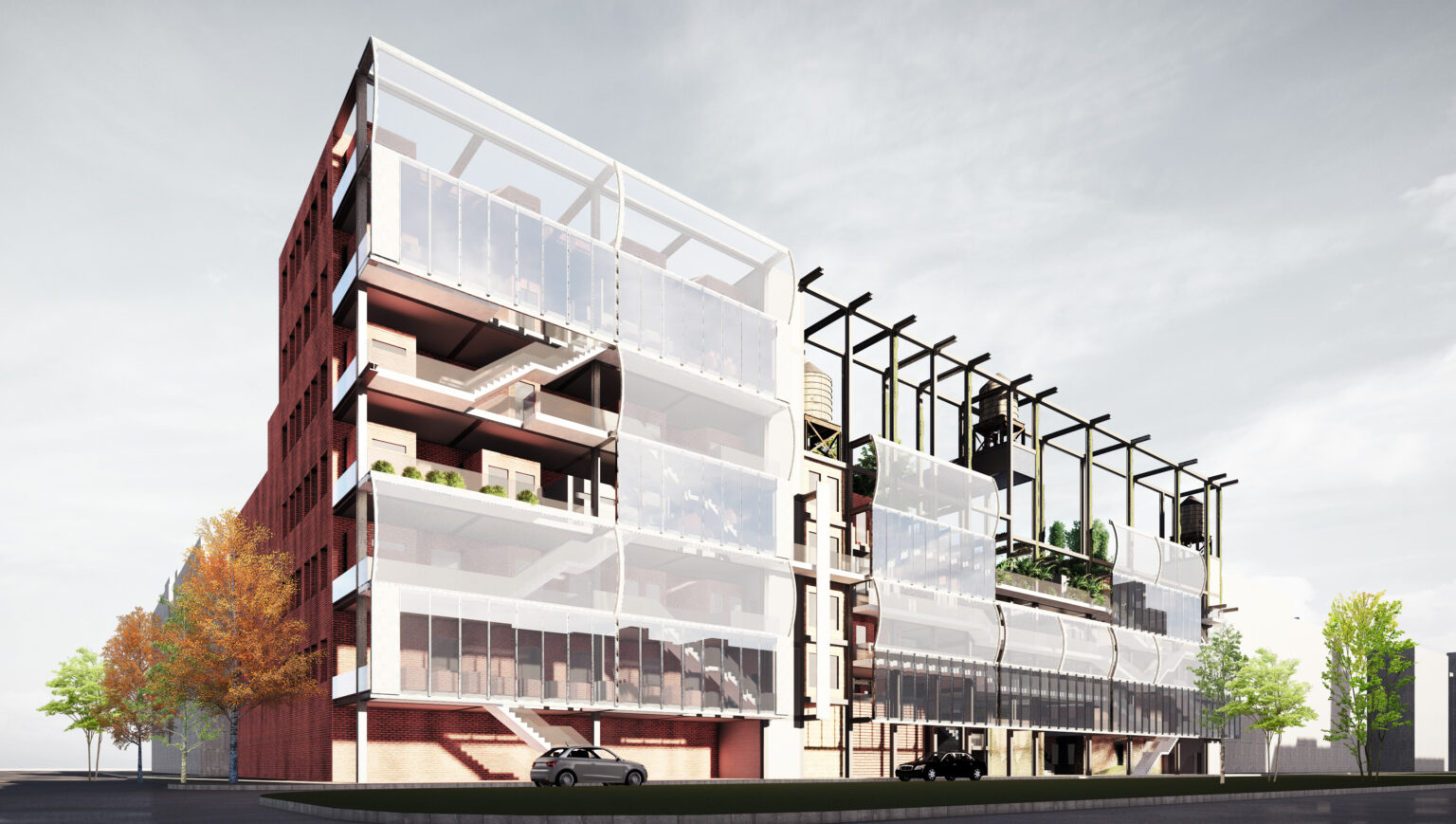
Our project is proposing a new scaffold that is embedded within the existing city block’s DNA. Our project constructs a new public forum by bringing individuals back to collectives, connecting individual buildings to become a large public field, and possibly becoming a macro field condition for the city.
Using those existing tenement buildings as the reference to constructing a scaffolding condition allows building programs to become fragmented, it becomes possible to introduce different programs in different places freely, while allowing the circulation to connect with existing buildings in order to create a large field condition.
Those fragmented programs compose a new way to experience the city, pedestrians could walk up to different parts of buildings to prepare their meals, or take a hot bath after running
or exercising in the city, or even come to the public living room to catch an NBA game. Using those fragmented programs in the scaffolding would not only give homeless people a place to live but also would help them come back to the collective community.
Because the scaffolding structure was based on existing tenement buildings, the circulation would also connect to existing buildings, which means the community would merge together and share those public spaces. By opening parts of those existing tenement buildings and modifying programs, the individual building would also be merged and share a common program. In other words, those field conditions are not only happening within the scaffolding structure but the entire city block. Scaffolding the margin enables editing the city by editing the city blocks, editing the city blocks by editing existing individual buildings, and editing individual buildings by editing fragmented programs.
This project rethinks the relationship between programs and buildings, how individual program fragments could change the civic experience; public and private, how private space would be open up and become public and shared with; existing buildings with ordinary people, and new buildings with homeless people.
As it becomes more and more gentrified, New York City still has many residual spaces that are left underdeveloped. As Manuel Castells and David Harvey have written, inequality in investment leads to uneven development throughout cities. Yet underdeveloped areas have the potential to become a place for social welfare as living spaces for unhoused people. We take one such area, namely the Allen Street intersection with Delancey Street as the site for our project “Scaffolding The Margin”. Scaffolding in pedagogical meaning is a method where teachers offer a particular kind of support to students as they learn and develop a new concept or skill and eventually become self-reliant. In the social context, the unhoused people are regarded as marginal, people who are left behind. In an architectural context, marginal space would be those leftover residual spaces. Scaffolding the margin means using the architectural residual spaces to help the unhoused people eventually form a self-reliant community.
Allen Street has a unique characteristic that was the result of the city’s development: Half of the city block was demolished in order to create a wider driveway. For those city blocks, what was the backside of the building became the front facade of the building, and buildings lost their rear yards and were left with some liminal residual spaces in front of the facade.
Our project is proposing a new scaffold that is embedded within the existing city block’s DNA. Our project constructs a new public forum by bringing individuals back to collectives, connecting individual buildings to become a large public field, and possibly becoming a macro field condition for the city.
Using those existing tenement buildings as the reference to constructing a scaffolding condition allows building programs to become fragmented, it becomes possible to introduce different programs in different places freely, while allowing the circulation to connect with existing buildings in order to create a large field condition.
Those fragmented programs compose a new way to experience the city, pedestrians could walk up to different parts of buildings to prepare their meals, or take a hot bath after running
or exercising in the city, or even come to the public living room to catch an NBA game. Using those fragmented programs in the scaffolding would not only give homeless people a place to live but also would help them come back to the collective community.
Because the scaffolding structure was based on existing tenement buildings, the circulation would also connect to existing buildings, which means the community would merge together and share those public spaces. By opening parts of those existing tenement buildings and modifying programs, the individual building would also be merged and share a common program. In other words, those field conditions are not only happening within the scaffolding structure but the entire city block. Scaffolding the margin enables editing the city by editing the city blocks, editing the city blocks by editing existing individual buildings, and editing individual buildings by editing fragmented programs.
This project rethinks the relationship between programs and buildings, how individual program fragments could change the civic experience; public and private, how private space would be open up and become public and shared with; existing buildings with ordinary people, and new buildings with homeless people.